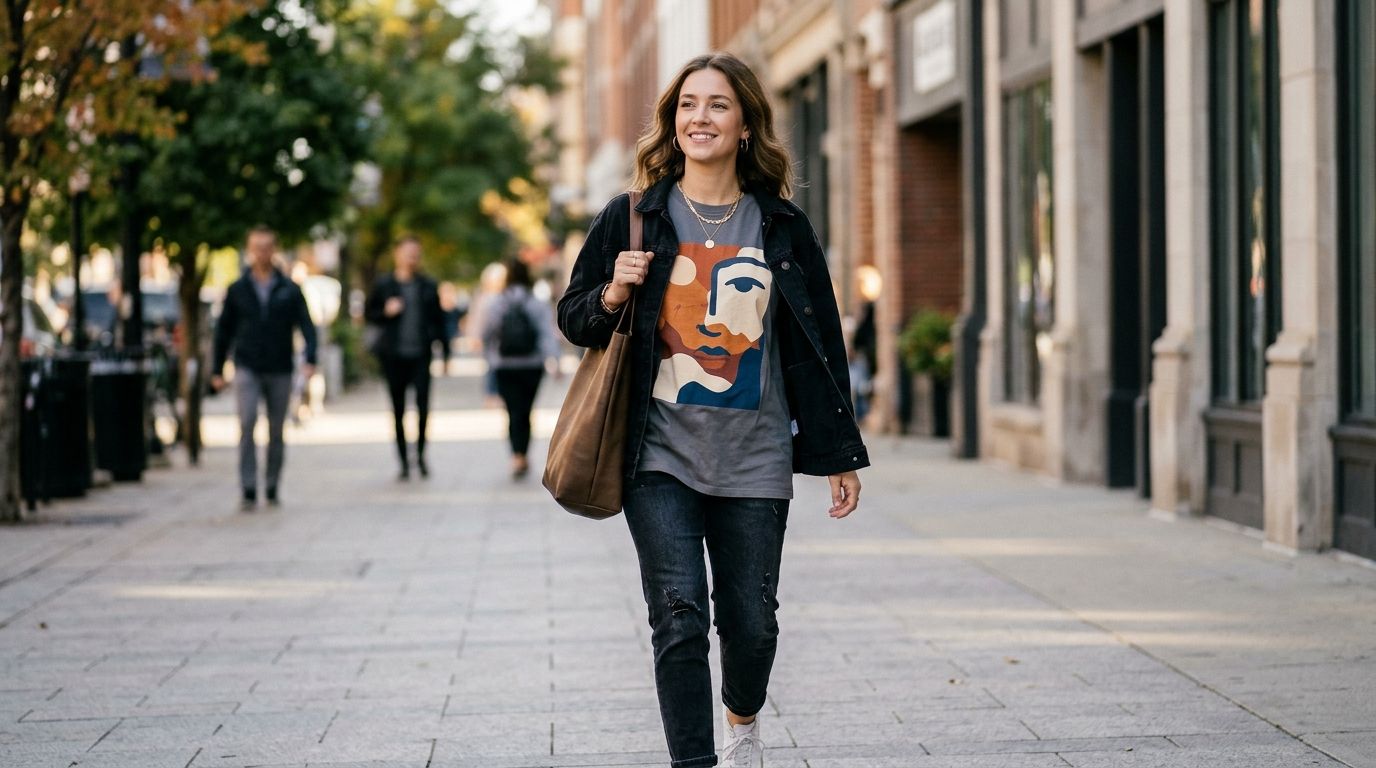
Wear statement t shirts under an open jacket by keeping the artwork or message visible between the jacket’s front panels. Let the tee lead, then choose trousers and shoes that support it instead of adding another competing statement. Before you leave, check that the jacket doesn’t turn the wording into half a sentence.
- Wear statement t shirts with an open jacket that frames the artwork rather than covering its meaning.
- Purcshirts statement t shirts suit urban creatives who want artwork, humor, or motivation to lead an outfit.
- Choose quiet supporting pieces when a graphic tee already carries a loud message.
- Check the outfit standing and sitting; the jacket opening changes as you move.
How do you wear statement t shirts under an open jacket?
Treat the jacket as a frame, not a second headline. For this 2026 outfit guide, use the following sequence to build around what your shirt actually says or shows.
- Choose the message. Decide whether artwork, sarcasm, or encouragement is doing the talking. Start with a shirt you want people to notice, not one you need the jacket to rescue.
- Frame the graphic. Put the jacket on and leave it open. Check whether its edges cover important letters, a face, or the part of the image that gives the design meaning.
- Quiet the supporting pieces. Start with plain trousers and uncomplicated shoes. Add detail only after the shirt and jacket work together.
- Check the proportions. Look at where the tee ends relative to the jacket and trouser waistband. Avoid bunching that breaks up the artwork.
- Test the movement. Sit, walk, and reach forward. If the jacket repeatedly hides the punchline, change the pairing rather than constantly pulling the panels apart.
The starting point is the design, not a prescribed jacket color. Browse Purcshirts for graphic t-shirts and long-sleeve tees built around streetwear, motivational, and funny messages, then judge each pairing by how clearly that particular design reads.
Why this matters
A statement shirt gives your outfit a point of view. Cover the important part, and you lose the reason you chose it. Add too many competing details, and you make that point harder to read.
For your 2026 wardrobe, separate personal expression from decoration. You don’t need every piece to announce your taste at once. A plain jacket can give bold artwork room; a detailed jacket asks the tee to share attention.
The strongest pairing preserves the shirt’s meaning. That matters just as much for a positive message as it does for a sarcastic joke. Neither works well when the opening leaves only disconnected words visible.
Which jacket works best with your statement tee?
Choose the jacket by the role you want it to play. These are styling options, not rules about what you’re allowed to wear. The useful question is whether the combination gives your chosen design enough space.
| Jacket option | Best for | What works | What to watch |
|---|---|---|---|
| Plain denim jacket | Artwork-led casual outfits | Gives a graphic a clear surrounding layer | Patches, distressing, and strong washes can compete with detailed artwork |
| Bomber jacket | A bold tee with a defined outer outline | Keeps attention around the torso | Its front edges can cover the sides of a wide design |
| Overshirt | Relaxed outfits built around a message | Creates an uncomplicated open front | A strong check pattern can fight with busy lettering |
| Unstructured blazer | Intentional contrast between tailoring and a graphic | Makes the tee the informal element | Lapels can interrupt wording near the upper chest |
Don’t pick a jacket just because it belongs to the same style category as the tee. Check the actual outline. A jacket that looks right on its own can still be wrong for the placement of your print.
Plain denim jacket: best for artwork-led casual outfits
Start with denim when you want a familiar casual frame around the image. Keep the jacket’s own decoration restrained if the tee already contains detailed illustration or several colors.
The trade-off is visual texture. A heavily worked jacket adds another layer of information, so pair it deliberately rather than assuming all denim acts like a neutral.
Bomber jacket: best for a bold central graphic
Try a bomber when you want the shirt to sit inside a distinct outer silhouette. Leave the front open and inspect the full design, especially anything that stretches toward the sides of the chest.
Don’t size the pairing by the neckline alone. A visible collar tells you nothing about whether the jacket covers the main artwork lower down.
Overshirt: best for message-first casual dressing
Use a plain overshirt when the wording should remain the obvious focal point. Keep the opening relaxed rather than arranging the edges into a narrow strip down the center.
Pattern is the main decision. If you want a checked overshirt, simplify the rest of the outfit and make sure the lettering still stands apart from it.
Unstructured blazer: best for deliberate dress-code contrast
Choose a blazer when you want a graphic tee to interrupt a more tailored outfit. Keep the trousers straightforward so the contrast reads as intentional rather than unfinished.
A blazer doesn’t automatically make a sarcastic message suitable for work or an event. The words still set the tone. Check the occasion before you check the lapels.
Why the right open-jacket pairing varies
There is no universal jacket for every statement shirt. Use these factors to judge the combination in front of you:
- Graphic placement. Artwork near the neckline interacts differently with lapels than a design placed lower on the torso.
- Design width. A narrow central image needs a different opening from lettering that stretches across the chest.
- Message structure. A joke needs its setup and punchline; a short positive phrase needs its key words intact.
- Visual competition. Checks, patches, jewelry, and decorated trousers all ask for attention alongside the tee.
- Occasion. A message that suits a casual music night doesn’t automatically suit a client meeting or a family gift occasion.
- Movement. A pairing should work when you sit or walk, not only when you hold still in front of a mirror.
For a 2026 outfit refresh, change the piece causing the conflict first. If the jacket covers the message, replacing the trousers won’t solve the problem.
Build an outfit around the kind of statement you want
Start with personality. Then choose the visual balance. Purcshirts offers streetwear, motivational, and irreverent or funny designs, so the useful distinction is the attitude you want to wear—not an invented hierarchy of which message is more stylish.
| Shirt direction | Best for | Supporting outfit | Strength | Trade-off |
|---|---|---|---|---|
| Artwork-led graphic | Urban creatives who want the image to lead | Plain open jacket, understated trousers, simple shoes | Makes the illustration the obvious focus | Detailed outerwear can crowd the image |
| Funny or sarcastic message | Shoppers who enjoy readable humor | Quiet jacket front and restrained accessories | Gives the words room to land | The joke needs to suit the audience |
| Positive message | Encouragement shoppers and thoughtful gift buyers | Open layer that preserves the complete phrase | Keeps the intended sentiment clear | Covered words can change or weaken the message |
Let artwork lead without matching everything
Choose one color from the graphic if you want a connection elsewhere in the outfit. Repeat it in a small way, or leave the supporting pieces neutral. Both are useful approaches; neither requires matching every item.
Avoid turning the illustration into a shopping checklist. If the shirt contains several colors, you don’t need to reproduce all of them in your shoes, jacket, and accessories. Let some of the design belong to the tee alone.
Give a joke room to land
Read the message aloud before styling it. That simple check tells you which words must remain visible for the joke to make sense.
Next, look at the complete outfit. A sarcastic shirt already supplies attitude; it doesn’t need a second slogan across the jacket or another punchline on an accessory. Keep the humor readable, not repeated.
Keep a positive message intact
Choose the layer around the sentiment you want to show. If the jacket hides the word that makes the phrase encouraging, the pairing needs adjusting.
For gifts, start with the recipient’s language and taste. Don’t buy a message simply because you agree with it. Picture whether that person would wear it outside the house and which jacket they already reach for.
Check the outfit from more than the front
Use 2 views before calling the outfit finished: straight on and from the side. The front shows whether the message reads; the side shows whether the tee has gathered under the jacket or caught around the waistband.
Then sit down. You’re checking the arrangement, not demanding that every letter stay visible through every movement. The practical goal is an outfit that settles naturally without constant fixing.
Keep 1 focal point as your starting rule. You can add complexity later, but first make the shirt-and-jacket combination work without assistance from extra accessories.
Should you tuck in a statement t shirt under a jacket?
Tuck in a statement t shirt only when the tuck preserves the design and gives you the outline you want. If the artwork extends toward the hem, check what disappears below the waistband before deciding.
Try the outfit both ways. A tuck isn’t an upgrade by default, and an untucked tee isn’t automatically more relaxed if it keeps bunching beneath the jacket.
Can you wear a long-sleeve graphic tee under an open jacket?
Wear a long-sleeve graphic tee under an open jacket when the sleeves sit comfortably and the chest design remains clear. Check the cuffs as well as the front opening.
If you deliberately show the tee’s cuffs, make that detail part of the outfit. If they gather awkwardly, adjust the pairing instead of pushing fabric around all day.
How do you avoid overdoing a graphic tee outfit?
Remove the detail that competes most directly with the shirt. That might mean choosing a plain jacket, changing patterned trousers, or leaving off a prominent accessory.
For 2026, use subtraction before replacement. You don’t need an entirely new outfit when removing a competing element lets the original message read clearly.
FAQ
What's the best jacket to wear with statement t shirts?
The best jacket for statement t shirts leaves the important artwork or wording visible. Start with a plain denim jacket, bomber, overshirt, or unstructured blazer, then judge the actual opening rather than the category name.
Should my jacket match a color in my graphic tee?
Your jacket doesn't have to match a color in your graphic tee. Repeating one color is an option, but a quiet supporting color also lets the artwork lead.
Can I wear a patterned jacket over a statement shirt?
Wear a patterned jacket over a statement shirt when the pattern doesn't obscure or compete with the message. Keep other pieces restrained and check whether the wording remains easy to read.
Should a graphic tee hang below an open jacket?
A graphic tee can hang below an open jacket if the resulting proportions look intentional to you. Check the hem from the front and side, and avoid bunching that distorts the design.
How do I style a sarcastic shirt without overdoing it?
Style a sarcastic shirt with a quiet jacket and supporting pieces that don't introduce another slogan. Keep the complete joke visible and choose the message for the people and occasion.
Is a statement t shirt a good gift for someone creative?
A statement t shirt is a good gift when its artwork or message fits the recipient's actual taste. Choose around their interests, sense of humor, and existing wardrobe rather than your own favorite phrase.
One last thing
Read the shirt with the jacket on. Not the shirt alone. That catches the mistake a color check misses: an outfit can coordinate perfectly while the jacket hides the part that makes the design yours.
For your next 2026 outfit, choose the Purcshirts statement tee whose message you actually want to wear. Then make the surrounding pieces give it space. The jacket is the frame. Your point of view is the subject.